
All About Tarot
For centuries, tarot cards have captured people’s imaginations, providing a window into the mysteries of the universe and the human psyche. While to an untrained eye tarot reading may appear to be a card game, these cards are anything but. Tarot cards serve as both tools of fortune-telling and a gateway to self-discovery, offering valuable information about our present, past, and future.
Despite being around for hundreds of years, there’s still an air of mystery that surrounds tarot and tarot readings. We’re here to shed some light.
In this page, tarot reader and spiritual coach Chasity Leonard introduces us to the fascinating world of tarot reading, exploring the history of tarot, what happens in tarot reading, and more.
Tarot card reading is a form of cartomancy or self-reflection that uses a deck of tarot cards to gain insight into a person’s past, present, or potential future circumstances. It is often used as a tool for personal growth, counseling, and uncovering one’s inner, subconscious knowledge rather than absolute fortune-telling.
What is the Tarot?
The Tarot is a symbolic map of consciousness that encompasses our journey through life, both spiritually and practically.
Tarot reading is the practice of divining wisdom and guidance through a specific spread (or layout) of Tarot cards. However, contrary to popular belief, the cards do not simply tell your fortune, and one does not have to be a psychic to give Tarot readings. The cards are meant to provide insight into the innermost truths of your higher self. In other words, the cards provide an evolved awareness of what you already know deep within. The origin of the Tarot is unknown, but we do have documented references of Tarot card use back to fourteenth century Europe. The Tarot has been used as an oracle, in the basic form we know today, since the beginning of the seventeenth century.
The Meaning of the Tarot
There are 22 cards of the Major Arcana, which divulge greater secrets, and 56 cards of the Minor Arcana, which divulge lesser secrets and are further divided into four suits. The suits of the Minor Arcana include Wands, Swords, Cups, and Pentacles. The fourteen cards in each suit are numbered Ace through Ten, plus the Court Cards: Page (Princess), Knight (Prince), Queen, and King. Decks can vary some in naming.
The suits and the individual cards are not always called the same thing, but their core meanings are fairly universal. For example, in some decks, the Knight equates to the King and not the Prince. Most decks come with a booklet you can use to get familiar with its specifics. The Minor Arcana of the Tarot symbolize daily aspects of life, giving insight into our challenges, talents, opportunities, and experience of ups and downs. Each suit represents an element: Wands are Fire, Swords are Air, Cups are Water, and Pentacles are Earth. The suits can reflect attitude and temperament, such as a fiery person or someone who is “up in the air” or “down to earth.” Determining a card’s significance is dependent upon the question, the reader, the person receiving the reading, and the placement of other cards in the spread.
The Major Arcana are numbered 0 through 21, starting with The Fool, and ending with The World. These cards align with the milestones of life’s story or The Hero’s Journey which can be explored further with Joseph Campbell’s book “The Hero With a Thousand Faces.” In this sense, the cards of the Major Arcana represent the 22 inevitable phases or passages of every journey, which we’ll all encounter during our lives (not necessarily in this order). It’s also possible for these phases to repeat themselves, and recur multiple times throughout one’s life, creating a cyclical nature in which there is no true beginning or end.
What is a tarot card spread?
A tarot spread is the pattern in which you lay your tarot cards out. The location of the cards in the pattern signifies a specific meaning in the reading. A spread can be as small as a single card, say for a daily reading, or 10 or more.
There are many different types of tarot spreads, with the most classic being the Celtic Cross Spread. This spread constitutes 10 cards, six cards laid like a cross and four in a column to the right of it. Other popular spreads include the career path spread, the horseshoe spread, and the relationship spread.
Types of Tarot Spreads
There are many types of Tarot spreads. Perhaps the most classic is an eleven-card layout called The Celtic Cross (11 cards including the Significator). There is also a Tree of Life spread, a Planetary spread, the Tetraktys spread, and the Pentagram spread, among many, many others. Some readers like to do simpler, smaller spreads using only three cards. A three-card spread can have many interpretations in and of itself, such as Past-Present-Future, Mind-Body-Spirit, or Situation-Action-Outcome. The variation of three-card spreads is virtually endless.
Reversed Tarot Cards
Tarot card illustrations are generally a single image in an upright position, unlike common playing cards that display a dual image facing both right-side-up and upside-down. When Tarot cards are collected and shuffled or moved about, they can show up upside-down in a reading. The reversed Tarot card can be interpreted in various ways. Many believe this simply means the significance of the card is present in your life, but its powers are weakened or blocked by something. Others believe it means you’re unwilling to work with the energy the card signifies. And yet others interpret a reversed Tarot card to mean that the opposite or inverse of that card’s significance is present.
Some deck booklets (such as the classic Rider-Waite) provide you with an official “reversed” meaning along with the main divinatory significance of each card. When learning the Tarot, it’s advisable to stick with right-side-up interpretation, simply turning the card around if it falls upside-down, at least in the beginning. Many people omit the potential confusion of reversed cards by turning them all right-side-up and exploring the full spectrum of energy at play, including both shadow and light expressions.
Understanding the tarot deck structure
Nearly all tarot decks follow the 78-card structure. A standard tarot deck is divided into 22 major arcana cards and 56 minor arcana cards. The minor arcana are further divided into four suits: cups, coins or pentacles, wands, and swords.
Major arcana: The major arcana represents the primary themes of human life, such as love, death, change, acceptance, and spirituality. The 22 major arcana cards can be interpreted as the 22 steps of “The Fool’s Journey”— helping us understand where we are in our own life’s journey. Some examples include:
- The Wheel of Fortune
- The Devil
- The Lovers
- The Fool
- The Magician
- The Sun
Minor arcana: The minor cards are considered inferior to the major cards because they focus on the less important archetypes and minor mysteries of life, like emotions or conflict. A minor arcana suit is similar to playing cards, consisting of an ace, numbered cards, and court cards:
- Ace of Wands
- Two of Wands
- Three of Wands
- Four of Wands
- Five of Wands
- Six of Wands
- Seven of Wands
- Eight of Wands
- Nine of Wands
- Ten of Wands
- The Page of Wands
- The Knight of Wands
- The Queen of Wands
- The King of Wands
There are many types of tarot decks, and they may use different structure, symbols, or imagery than the deck described above (based on the Rider Waite Smith Tarot). For example, the Tarot de Marseilles has “The House of God” in place of “The Tower.” The Rider Waite Smith Tarot Deck is one of the most well-known and most-used tarot decks, with many other decks taking inspiration from it.
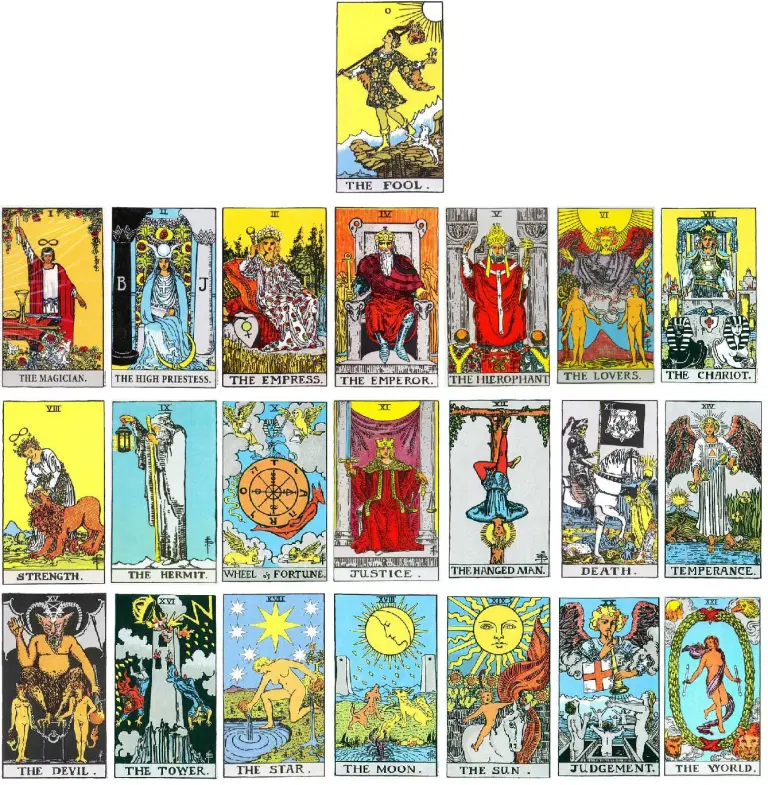
The Major Arcana are the named cards in a cartomantic tarot pack. There are usually 22 such cards in a standard 78-card pack, typically numbered from 0 to 21 (or 1 to 21, with the Fool being left unnumbered). Although the cards correspond to the trump cards of a pack used for playing tarot card games, the term ‘Major Arcana’ is rarely used by players and is typically associated exclusively with use for divination by occultists.
The Major Arcana are complemented by the Minor Arcana—the 56 unnamed cards of the tarot deck, which more directly correspond to the contemporary standard 52-card deck.
The 22 Major Arcana Cards
0 The Fool
When The Fool is pulled in a reading, it signifies a time of new beginnings that requires courage and a willingness to take a leap into an entirely new cycle or phase or life. The Fool embodies a desire for adventure, filled with wonder and youthful innocence.
I The Magician
The Magician is the master of communication and timing. When you pull The Magician, it reflects a time to make things happen by using the power of your mind, words, voice, and ability to share your ideas. It’s time to make your own magic.
II The High Priestess
Pull the High Priestess and accept the invitation to your deepest self. The High Priestess is intuition, self-trust, and the domain of the subconscious lunar landscape. She reminds you to trust your intuition and tune in to your inner wisdom and resources.
III The Empress
When the Empress appears, you’ve invoked the Earth Mother, who’s a symbol of the ability to give and receive love and nurturing in a healthy balance. The Empress is comfortable in her body, enjoys sensual pleasures, and uses her creativity to birth the world.
IV The Emperor
When you pull the Emperor, you’re in the realm of personal power and leadership ability. He reflects your capacity to take charge with courage and initiate projects. The Emperor often shows up when it’s time to be your own boss in some way or move into the driver’s seat.
V The Hierophant
The Hierophant is the spiritual learning and teaching card and can bring us face-to-face with the beliefs, religion, and traditions we’ve adopted. He can signify a time of spiritual growth or initiation, and a mentor or teacher might step into your life.
VI The Lovers
The Lovers card is the art of relationship, within us and without. It’s the union of opposites, bringing two things together, and can reflect the need to make a choice or decision between two situations or two people. The Lovers asks you to look at how you approach, choose, and surrender to love.
VII The Chariot
The Lovers card is the art of relationship, within us and without. It’s the union of opposites, bringing two things together, and can reflect the need to make a choice or decision between two situations or two people. The Lovers asks you to look at how you approach, choose, and surrender to love.
VIII The Strength
We’re all learning to balance our primal animalistic nature with our social civilized selves, and Strength is this phase of our evolution. When you pull Strength, you’re called to express your passion, instincts, and creativity. Renewed vitality and excitement for life await you.
IX The Hermit
Holding the Star of Hope in his lantern, The Hermit represents your inner wisdom and the ability to light your own path. You may be entering a time of solitude and reflection which will reveal the next steps in perfect time. Explore your inner worlds by taking time away from external distraction.
X The Wheel of Fortune
The Wheel turns in fortunate directions for those who believe and allow the movement to take them toward new opportunity. When you pull The Wheel, be open to breakthrough and prosperity. Be willing to enter the unknown, the place where “luck” in the form of something new is possible.
XI Justice
When Justice shows itself, you’re in a phase of balance and realignment. It’s time to weigh-in with yourself and release some of the baggage you’ve accumulated that keeps you off-center. Justice wants harmony in all areas of life – relationships, health, finances, and work.
XII The Hanged Man
In a reading, The Hanged Man shows the need to see things from a new perspective, hence hanging upside-down. When you pull this card, you’re ready to surrender something and break old patterns. It’s time to see through your illusions.
XIII Death
Death is the card of rebirth that comes when you let go of what is already dead. This is not typically the card of physical death, it’s an invitation to detach from the dead weight you’re lugging around and transform into a new phase of life. In this way, you powerfully regenerate yourself.
XIV Temperance
When you pull Temperance, you’re going through, or about to go through a period of integration – things are coming together. At times, it may feel like very little is happening on the outside, but on the inside, you’re alchemizing and creating something new that will soon express itself.
XV The Devil
The Devil seems to make fun of us and this card is indeed a reminder not to take life so seriously. We’re the ones who tie ourselves up with expectations, judgments, and fear. While The Devil can be a warning to take responsibility for our earthly desires and impulses, it’s equally a reminder to laugh at how we “bedevil” ourselves.
XVI The Tower
Time to take down what isn’t working, clear the rubble, and build something new. The Tower is a wake-up call. You have the power to undo anything that isn’t in alignment with your true desire, nature, and purpose. It’s time to renovate your life.
XVII The Star
When you pull The Star, feel the renewal of life that a fresh outlook and hope bring. You’re being reminded of your value in society and how you shine brightly in your own unique ways. Take advantage of this time of healing, especially your self-esteem. You may receive public recognition.
XVIII The Moon
The Moon calls you to embrace the mystery and all that you can’t reason out or define. Sometimes, when The Moon appears in a reading you will not have clarity right away. It may not be time to know the answer. You may be called into the depths of your soul where images and feelings arise for interpretation.
XIX The Sun
When you pull The Sun, the principle of co-creation, get ready to shine in ways that inspire and motivate others. Just as the Sun in our solar system provides warmth and light, you too are a sun for others on the planet. Let go of things that leave you feeling drained. Follow your heart and team up with others who make you feel excited to be alive.
XX Judgement
Judgement in a reading highlights the importance of employing good judgment, with a broad perspective, fairness, and objectivity. It may be time to look at your relationship with judgment itself. All of this serves as a path to rebirth or awakening, so you can emerge transformed. You may be ready to follow a new calling.
XXI The World
Your hard work has paid off! When The World appears for you, you’ve reached the end of a cycle, which inherently means you’re also starting a new one. And this new cycle is the understanding and experience that it’s all one. All cards of the Tarot culminate in The World. It’s the totality of everything; wholeness. You’re unlimited in your ability to share your gifts with the world, travel, and fully participate in the cosmic dance..
The history of tarot
Tarot cards first appeared in Europe in the late 15th century. Artists developed the first deck of cards to depict archetypes of the times, characters influenced by folk beliefs and practices with ancient roots. During this period, cards were used to play games. However, by the 18th century, people began to give meanings to each card, including suggestions on how various cards could be laid out for divinatory purposes.
Modern tarot owes a lot to the Order of the Golden Dawn, a London-based group active in the late 19th and early 20th centuries. Golden Dawn member Arthur Edward Waite commissioned the drawings for a deck of tarot cards from fellow member Pamela Colman Smith, a gifted artist. Through their collaboration, the deck was published as the Rider-Waite deck after Waite himself and Rider, the publisher, snubbing Smith entirely.
However, the modern tarot community acknowledges Smith’s instrumental role in the creation of the deck and calls it the Smith Waite deck, or Rider Waite Smith deck. This deck has become a classic of our time, and most modern decks are based in some way on these beautiful and richly symbolic illustrations.
Like the early Italian-suited packs on which they were originally based, in a cartomantic pack each Major Arcanum depicts a scene, mostly featuring a person or several people, with many symbolic elements. In many decks, each has a number (usually in Roman numerals) and a name, though not all decks have both, and some have only a picture. Every tarot deck is different and carries a different connotation with the art, however most symbolism remains the same. The earliest, pre-cartomantic, decks bore unnamed and unnumbered pictures on their trionfi or trumps (probably because a great many of the people using them at the time were illiterate), and the order of cards was not standardized. Strength is traditionally the eleventh card and Justice the eighth, but the influential Rider–Waite Tarot switched the position of these two cards in order to make them a better fit with the astrological correspondences worked out by the Hermetic Order of the Golden Dawn, under which the eighth card is associated with Leo and the eleventh with Libra. Today many decks use this numbering, particularly in the English-speaking world.
The following is a comparison of the order and names of the Major Arcana and including the Rider–Waite–Smith and Crowley (Thoth) decks:
| No. | Tarot de Marseille | Rider–Waite | Golden Dawn | Book of Thoth (Crowley) |
|---|---|---|---|---|
| 0[i] | The Fool | The Fool | The Fool | The Fool |
| I | The Juggler | The Magician | The Magician | The Magus[c] |
| II | The Popess | The High Priestess | The High Priestess | The Priestess |
| III | The Empress | The Empress | The Empress | The Empress |
| IV | The Emperor | The Emperor | The Emperor | The Emperor |
| V | The Pope | The Hierophant | The Hierophant | The Hierophant |
| VI | The Lovers | The Lovers | The Lovers | The Lovers |
| VII | The Chariot | The Chariot | The Chariot | The Chariot |
| VIII | Justice | Strength | Strength | Adjustment |
| IX | The Hermit | The Hermit | The Hermit | The Hermit |
| X | Wheel of Fortune | Wheel of Fortune | The Wheel of Fortune | The Wheel of Fortune |
| XI | Strength | Justice | Justice | Lust |
| XII | The Hanged Man | The Hanged Man | The Hanged Man | The Hanged Man |
| XIII | (unnamed) | Death | Death | Death |
| XIV | Temperance | Temperance | Temperance | Art |
| XV | The Devil | The Devil | The Devil | The Devil |
| XVI | The House of God | The Tower | The Blasted Tower | The Tower |
| XVII | The Star | The Star | The Star | The Star |
| XVIII | The Moon | The Moon | The Moon | The Moon |
| XIX | The Sun | The Sun | The Sun | The Sun |
| XX | Judgement | Judgement | Judgement | The Aeon |
| XXI | The World | The World | The Universe | The Universe |
- often unnumbered
How to prepare for a tarot reading
When you book a tarot reading with a professional reader, get the most out of the reading by preparing. Tarot readings require your active participation and cooperation.
Here are a few ways to prepare for a tarot reading:
- Journal before the reading: Note down details about your life that you are hoping to uncover during the reading. This way, you’ll have better control over your true feelings and won’t overwhelm the reader.
- Respect your reader’s policies: Research your reader’s policies on their website or by asking their previous clients. Better still, you can ask your reader what their policies are. Doing this will help ensure you have a smooth reading.
- Mediate before the reading: Find a quiet, calming space and clear your heart and mind before the reading.
- Carry a notebook: Your reading will likely have many different facets. Taking notes is an excellent way of remembering them all. However, you should remember to concentrate on the reading while doing so.
- Don’t test your reader: While tarot reading is a magical craft, you shouldn’t expect your reader to know everything. Tell your reader relevant information about you to ensure you get an accurate reading.
How does tarot card reading work?
During a reading, the reader will look at the cards in the spread and see how they influence each other in order to interpret the meaning of the cards. For example, The High Priestess can be read as an encouragement of spiritual practice or approval of objectivity, depending on her placement and the question.
A reading also depends on whether the card is placed upright or upside down, called the reversed position. A reversed reading could mean a potential negative occurrence in the querent’s situation. For example, The Hermit, when upright, means there is a humble teacher in the situation, while The Hermit reversed means that the querent is resisting wisdom. However, two cards do not have any negative associations: The Sun and The World.
A skilled reader uses the cards as prompts to help the querent discover their own, sometimes hidden, motivations and behavior patterns and understand how the elements of their situation relate to one another.
Often, the cards aren’t there to provide new information but instead represent the situation in a way that helps the querent consider how to move forward. Sometimes, it just helps them to acknowledge something they know already but need a little confirmation about.
FAQs about the basics of tarot
What is tarot?
Tarot is a deck of cards that contain imagery and suits that each represent an aspect of life. The cards are read in combination with one another to interpret the meaning of a given moment or scenario. They create awareness of the moment’s potential and influences or bring a new perspective to the querent, the person receiving the reading. Tarot cards can help tap into deep, unconscious inner knowledge and offer valuable insights into one’s life, or they can portray hidden motives, opportunities, and potential to the querent (the person whom the reading is for). Importantly, tarot readings don’t describe unchangeable events.
What is tarot reading?
A tarot reading is a review of chosen tarot cards to interpret their meaning about a specific situation or question presented by the querent. You can do a tarot reading for yourself or have a professional tarot reader do one for you. During a tarot reading, the tarot deck is shuffled and then a tarot spread is placed down.
How many tarot decks are there?
It’s estimated that there are around 400 tarot decks, each representing ideas from religions, occultists, and brotherhoods.
Which is the Best Tarot Deck?
There is no “best” Tarot deck. The Rider-Waite is one of the oldest and most widely used decks, with original artwork dating back to the early 1900s. However, hundreds of decks with various themes have been created since then. You can find everything from fiction-based decks like Lord of the Rings, Alice in Wonderland, and My Little Pony, to other themes like Kamasutra, Steampunk, Hollywood, and even Gummy Bears (there’s really something for everyone). More universally relevant decks include The Crowley Thoth Tarot, The Golden Tarot, The Hermetic Tarot, The Wildwood Tarot, and many more. In choosing a deck, let your intuition guide you to whatever theme and imagery resonate with your soul and journey.
What do tarot cards tell you?
Most people wrongly believe that tarot cards predict the future, which they don’t. What they do is aid self-reflection, helping you consider a problem and find ways of solving it. They help you uncover the constructs of your inner processes.
Can tarot readers really read people well, or do they just have powers?
There are two approaches to analyzing the abilities of tarot card readers: the paranormal approach and the non-paranormal approach. The paranormal approach claims that supernatural forces are at work during tarot reading. On the other hand, the non-paranormal approach claims simple psychological effects are at play during tarot reading — meaning tarot readers know how to read people well. In short, it’s up to you which approach you believe!
How It Works
The process typically involves the following steps:
- Formulating a Question/Intention: The person receiving the reading (the “querent”) or the reader focuses on a specific question or area of concern, often open-ended, such as “What do I need to know about this situation?”.
- Shuffling and Drawing Cards: The tarot deck is shuffled, and a certain number of cards are selected, either by the querent or the reader.
- Laying Out a Spread: The selected cards are placed in a specific pattern, known as a “spread” (e.g., a three-card spread for past/present/future, or the more complex Celtic Cross). The position of a card within the spread influences its interpretation.
- Interpretation: The reader interprets the meaning of the cards based on their individual symbolism, their position (including whether they are upright or reversed), and how they relate to each other and the querent’s question. The reader weaves these meanings into a story that resonates with the querent’s current situation.
The Tarot Deck
A standard tarot deck consists of 78 cards, divided into two main parts:
- Major Arcana (22 cards): These represent major life events, significant themes, and spiritual lessons, often viewed as an archetypal journey through life (known as “The Fool’s Journey”).
- Minor Arcana (56 cards): These focus on daily aspects of life, emotions, challenges, and practical matters. They are divided into four suits, similar to a standard playing card deck, each associated with a different element and aspect of self:
- Cups (Water): Emotions and relationships.
- Pentacles (Earth): Material concerns, finances, and the physical world.
- Swords (Air): The mind, intellect, and challenges.
- Wands (Fire): Inspiration, action, and energy.
Purpose and Philosophy
The purpose of a tarot reading is generally to provide guidance, self-reflection, and new perspectives on an issue, rather than predicting unchangeable future events. Many modern practitioners view it as a psychological tool to access one’s subconscious mind, offering clarity and empowering the individual to make informed decisions and create their own path forward.
Key takeaways
- Tarot cards provide useful insights into our lives and can also be used as fortune-telling tools.
- Tarot cards can help you face your struggles by allowing you to find answers to your inner problems.
- The right cards usually come to the right people — meaning you can’t influence what your reading will be.
- Tarot reading is an art that requires you to understand the cards and the decks while also developing the right stories to tell the clients.
- There are numerous ways to prepare for a tarot reading, including journaling the issues you hope to fix before the reading, understanding the reader’s policies, and carrying a notebook.
References
- Bunning, J. (1998). Learning the Tarot: A Tarot Book for Beginners. In Google Books. Weiser Books. https://books.google.com/books?hl=en&lr=&id=he3J6UYYPakC&oi=fnd&pg=PR9&dq=how+to+learn+tarot+card+reading&ots=WnR6GjHdPC&sig=N7WRjX0W-yR2S-WcWQkj1IPPGCU&redir_esc=y#v=onepage&q=how%20to%20learn%20tarot%20card%20reading&f=false
- Ivtzan, I. (2007). TaroT Cards: a LiTeraTure review and evaLuaTion of PsyChiC versus PsyChoLogiCaL exPLanaTions. https://citeseerx.ist.psu.edu/document?repid=rep1&type=pdf&doi=585e615ae75daaafec0587929c54304b4f9025ce
- Williams, J., & Porter, J. (2021). The Religion of Tarot. https://research.library.mun.ca/15008/1/thesis.pdf